

Best Practices For Modeling Webflow CMS Collections For Blogs And Docs

If you’ve ever wrestled with messy CMS structures or inconsistent content, you know how much your architecture impacts speed, SEO, and editorial sanity. In Webflow, smart modeling of CMS Collections for blogs and documentation sets the foundation for fast publishing, trustworthy search results, and scalable content ops. Pair it with Notion as your writing hub and you get a streamlined system—especially when you bring in SyncFlow to automatically bridge Notion and Webflow.
Write in Notion — Design in Webflow. Start with the right model, then automate the sync.

Why modeling matters
- SEO: Clean slugs, consistent metadata, and logical relationships produce better internal linking and crawlability.
- Scale: Editors move faster when every post and doc follows the same schema.
- Consistency: Shared components (authors, categories) reduce duplication and errors.
- Automation: A well-defined model is far easier to sync from Notion to Webflow.
Recommended collection architecture
- Blog Posts (primary content for marketing/editorial)
- Docs Articles (knowledge base, product docs, how-tos)
- Authors (reference collection)
- Categories (could be separate for blog and docs, or shared if it makes sense)
- Topics/Tags (optional; use multi-reference sparingly and purposefully)
Tip: Avoid over-normalization. Keep it simple and focused on how your team actually works.
Essential fields for Blog Posts
- Title (plain text)
- Slug (lowercase, hyphenated, short). Example: how-to-model-webflow-cms
- Summary/Excerpt (short text for cards, search, and meta)
- Hero Image (image)
- Rich Content (Rich Text field)
- Author (Reference: Authors)
- Categories (Multi-reference: Blog Categories)
- Topics/Tags (Multi-reference or plain text list)
- Publish Date (date)
- Updated Date (date)
- Featured (checkbox)
- Estimated Read Time (number or auto-calculated externally)
- SEO Title (plain text)
- Meta Description (plain text)
- OG Image (image)
- Canonical URL (URL for duplicate or syndicated content)
Essential fields for Docs Articles
- Title (plain text)
- Slug (short, predictable). Example: install-syncflow
- Section/Category (Reference: Docs Categories)
- Related Articles (Multi-reference: Docs Articles)
- Version or Product Area (plain text or reference)
- Difficulty (plain text or option) — e.g., Beginner/Advanced
- Last Updated (date)
- Rich Content (Rich Text, with code blocks)
- SEO Title, Meta Description, OG Image (as above)
- Search Keywords (optional)
- Status (Draft/Published if you manage states separately from Webflow’s publish)
URL structure and slugs
- Keep URL paths short and human-readable.
- Consider folder-level clarity: /blog/your-post and /docs/your-article
- Avoid dates in slugs unless there’s editorial benefit.
- Use canonical URLs for cross-posted content.
Relationships that scale
- Authors: Store bio, headshot, role, and personal links in the Authors collection. Reference this from both Blog Posts and Docs Articles.
- Categories vs. Tags: Use Categories for high-level structure and a small set of Tags/Topics for discovery. Too many tags = noise.
- Related content: For docs, use a Related Articles multi-reference. For blog, consider a “Related Posts” multi-reference or build relationships dynamically via category/topic on Collection Lists.
SEO foundations you should model into the CMS
- Dedicated SEO fields: SEO Title, Meta Description, and OG Image per item.
- Image alt text: Encourage editors to add descriptive alt text on upload.
- Structured data: Insert Article or FAQ schema via custom code using CMS fields (title, author, date, etc.).
- Internal links: Encourage linking to related items. Keep your relationships clean for easy population.
From Notion to Webflow: map fields cleanly with SyncFlow Writing in Notion keeps your team in flow. SyncFlow handles the heavy lifting to get your content into Webflow automatically. It supports text, images, checkboxes, dates, URLs, code blocks with highlighting, TeX rendering, and even converts Notion page links into Webflow post links.
- Auto-Sync and Auto-Publish: Push updates whenever a Notion page changes.
- Versatile field types: Align Notion properties to Webflow fields with confidence.
- Styling control: Import with inline styles or use classes you design in Webflow.
- Code Highlighting and TeX Support: Perfect for docs, tutorials, and technical posts.
Get started with SyncFlow: https://syncflow.ybouane.com/
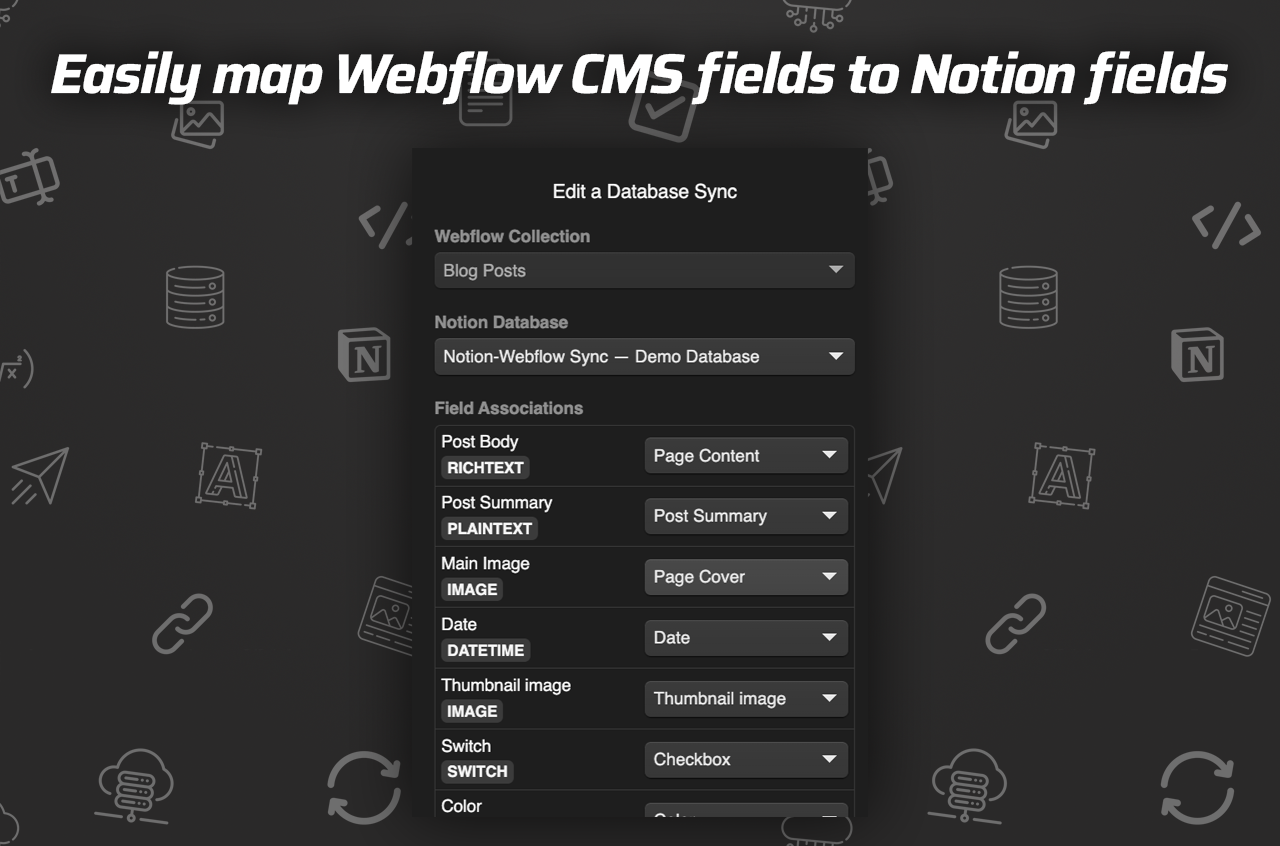
How to connect your Notion database to a Webflow collection 1) Visit SyncFlow and click Get Started: https://syncflow.ybouane.com/ 2) Grant access to your Webflow sites and sign in or create an account. 3) In Webflow Designer, open the SyncFlow app. 4) Connect Notion and choose the page or workspace you’ll sync from. 5) Click “Sync a new database,” then select the Webflow CMS collection to map. 6) Choose an existing Notion database or let SyncFlow create one for you. 7) Map fields (Title, Slug, Rich Text, Author, Categories, SEO fields, etc.). 8) Configure settings: Auto-Sync, Auto-Publish, code highlighting, TeX rendering. 9) Choose styling: Inline Styles or Use Classes for fully custom Webflow styling. 10) Save. Add a new Notion item and verify it appears in your Webflow CMS.
Pro modeling tips for blogs and docs
- Start with the editor experience: Fewer, clearer fields reduce friction and errors.
- Separate Blog and Docs collections: They evolve differently; keep their fields tailored.
- Normalize only where it helps: Authors and Categories as references; avoid over-splitting.
- Guardrails for slugs: Lowercase, hyphens, no special characters.
- Rich Text standards: Define heading levels, code blocks, callouts, tables—so content looks consistent when synced.
- Use statuses: A Notion “Status” property can map to a Webflow staging workflow.
- Plan for listing pages: Featured flag for home, category pages for taxonomy browsing, and search integration.
- Monitor CMS constraints: Keep an eye on Webflow’s limits for nested collection lists and references; design templates accordingly.
- Versioning for docs: If you version docs, add a Version field and a simple “Current” boolean for filtering.
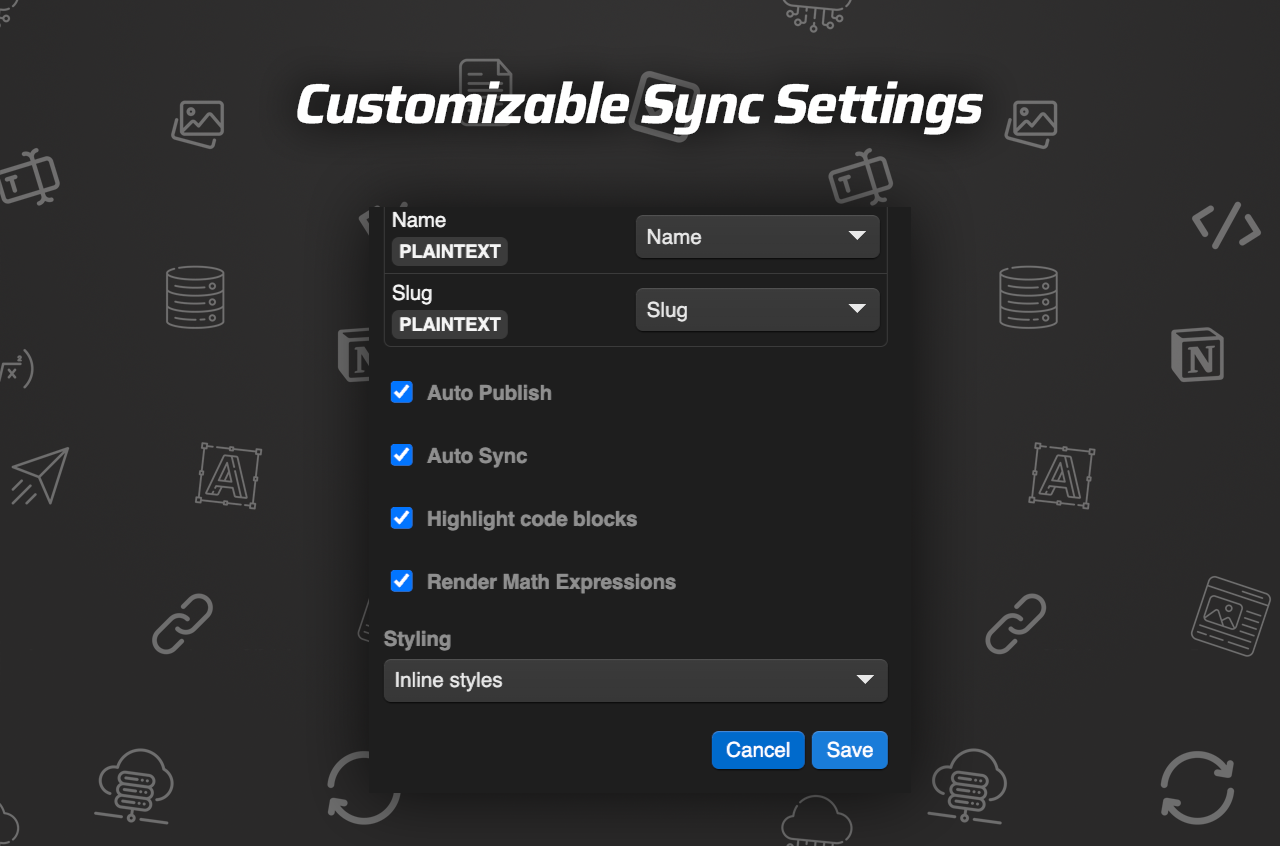
Notion property mapping suggestions
- Title → Webflow Name/Title
- Slug → Slug (generate from Title in Notion with a formula or fill manually)
- Tags/Topics → Multi-reference selection (ensure tags exist in Webflow collection)
- Author → Reference (sync authors first or map by unique name/email)
- Summary → Plain text Summary/Excerpt
- Content → Rich Text (supports code blocks and inline styles)
- SEO Title, Meta Description, OG Image → one-to-one fields in Webflow
- Last Updated → Date (automate via Notion last-edited-time if desired)
Editorial workflow that actually works
- Draft in Notion, using templates for blog posts or docs (pre-fill fields you modeled).
- Add internal links in Notion; SyncFlow converts them into Webflow links between posts.
- Review content previews in Webflow once synced; adjust classes if you chose class-based styling.
- Auto-Publish changes for fast iteration, or manual publish for tighter control.
Helpful resources
- Full tutorial video: https://www.youtube.com/watch?v=_890vYoe3KQ
- SyncFlow trailer: https://www.youtube.com/watch?v=HGjBCLL3anc
- Start syncing now: https://syncflow.ybouane.com/
A quick QA checklist before launch
- Do all items have SEO Title, Meta Description, and OG Image?
- Are slugs clean, consistent, and canonicalized when needed?
- Do Author and Category references resolve correctly on templates?
- Are Related Articles populated for docs?
- Is code highlighting and TeX rendering working on docs pages?
- Are Featured items pulling into the home or hub pages?
- Are images optimized with descriptive alt text?
Conclusion: Model smart, write fast, sync automatically When you model your Webflow CMS Collections for blogs and docs with clarity, everything else gets simpler—editorial workflow, SEO, and iteration speed. Use Notion as your writing cockpit, and let SyncFlow take care of reliable, real-time syncing into your Webflow CMS.
Get started with SyncFlow today: https://syncflow.ybouane.com/
Some images in this article were generated via AI tools and the article itself was proof-read with AI.


