

How To Export A Squarespace Site To Static HTML Safely

If you love designing on Squarespace but want the freedom, performance, and cost control of static hosting, exporting your site to clean HTML is a smart move. In this guide, you’ll learn a safe, repeatable workflow to export your Squarespace site to static HTML, CSS, JS, and media—then host it anywhere. We’ll specifically use ExFlow, a dedicated Squarespace exporter that can download your site and optionally sync it to S3, Git, or FTP, or even host it for you.

Why export a Squarespace site to static HTML?
- Performance and reliability: Static sites are fast, cacheable, and resilient.
- Cost control: Host on affordable static hosting without paying premium platform hosting.
- Portability: Keep a portable version of your site you can deploy anywhere and version-control.
- Security: No databases or server-side code to maintain.
Before you export: safety and readiness checklist
To export a Squarespace website safely, audit what will and won’t carry over to a static build:
- Dynamic features: Native forms, search, comments, scheduling, member areas, e‑commerce carts/checkout, and built‑in analytics are not inherently “static.” Plan replacements (third‑party form handlers, static search, comment embeds, analytics scripts) if needed.
- External embeds: Video, maps, and custom embeds typically still work if they’re client‑side. Verify embed scripts remain accessible.
- File ownership and permissions: Make sure you own or have rights to all content and media. Respect robots.txt and your platform’s terms.
- URLs and navigation: Ensure your site’s internal links are consistent and relative-friendly (absolute links still work, but relative is safer across hosts).
- Accessibility and SEO essentials: Confirm alt text, headings, meta titles/descriptions, canonical tags, and structured data are present before exporting.
How to export a Squarespace site to static HTML with ExFlow
ExFlow is built to export Squarespace (and Webflow) sites as static downloadable content. It supports exporting CSS, JS, images/media, and all pages, and it can output pages with .html extensions by default. You can then download a ZIP or sync directly to hosting.
1) Visit ExFlow and enter your site URL
- Go to https://exflow.site
- Paste your Squarespace site URL.
- If your site is password‑protected, you can provide the password for ExFlow to access content you own. Note: ExFlow can access password-protected Squarespace sites when the owner provides the password.
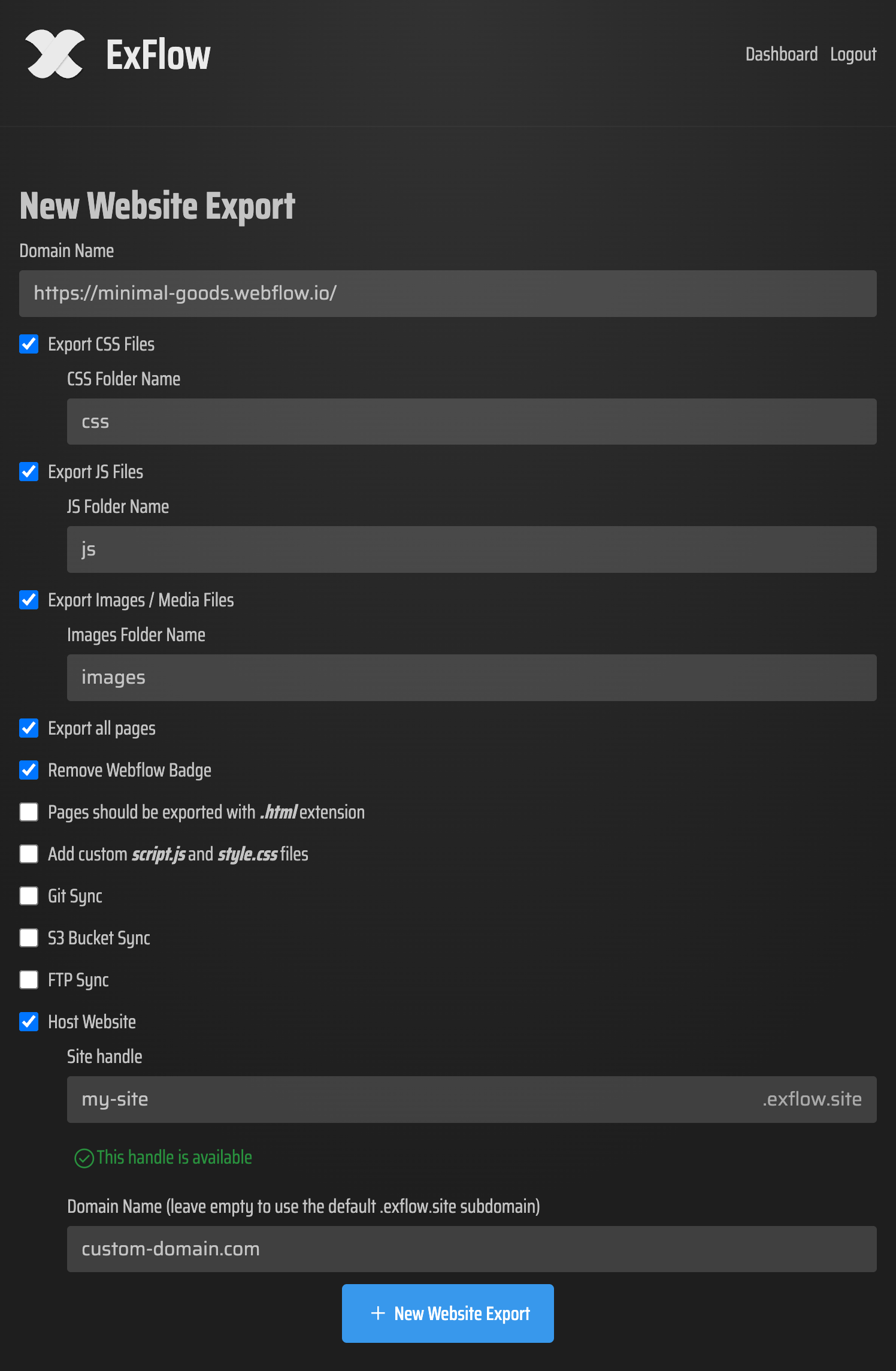
2) Configure export settings
- Export CSS, JS, images/media files: Capture your full visual design and assets.
- Export all pages: Pull in all public pages (and ensure pages are exported with .html extension).
- Add custom script.js and style.css: Inject your own enhancements if needed post-export.
- Optional: Enable Hosting, Git Sync, S3 Sync, or FTP Sync to push files where you want them.
3) Choose a destination
- Download a ZIP of your static site for manual deployment.
- Or sync automatically:
- S3 Sync for Amazon S3 static hosting
- Git Sync for Git-based workflows (e.g., GitHub Pages, Netlify)
- FTP Sync for traditional web servers
- Prefer zero‑setup? ExFlow can also host your exported site and let you link a custom domain with unlimited bandwidth depending on plan.
4) Run the export
- Click to export. ExFlow processes your site and prepares static HTML, CSS, JS, and media. When done, download the ZIP or let ExFlow sync it.

Post‑export: deploy and harden your static site
Where to host your static site
- Host on ExFlow: The simplest path—choose Hosting during export and manage everything from your ExFlow dashboard, including linking a custom domain. Learn more at https://exflow.site
- Amazon S3 (static website hosting): Point a domain (optionally via CloudFront), set index.html, and configure error documents.
- Git workflows: Push to a Git repo and deploy with GitHub Pages, Netlify, or similar.
- FTP server: Upload your /public files to your server’s web root. Ensure correct permissions and MIME types.
Security best practices for a safe migration
- Principle of least privilege: If you use S3, Git, or FTP sync, create dedicated credentials with minimal access. Rotate keys after setup.
- Protect secrets: Store API keys and passwords in a secure vault. Don’t commit them to your repository.
- HTTPS everywhere: Enforce TLS on your final host. Use HSTS and redirect HTTP to HTTPS.
- Content integrity: Set appropriate caching headers and consider Subresource Integrity (SRI) for third‑party scripts.
- Backups and rollback: Keep the exported ZIP as your offline backup. Version your site in Git for traceable changes.
SEO and performance checklist (don’t skip this)
- Canonical tags: Ensure each page has a correct canonical URL to avoid duplicates.
- Robots and sitemaps: Provide a robots.txt and sitemap.xml on your new host.
- Redirects: If URLs changed, add 301 redirects to preserve rankings and inbound links.
- Metadata: Validate titles, meta descriptions, Open Graph, and Twitter Cards.
- Images: Serve modern formats (WebP/AVIF where possible) and add descriptive alt text.
- CSS/JS optimization: Minify assets and preload critical CSS. Use async/defer for non‑critical JS.
- Analytics: Add your preferred analytics script to the exported site if needed.
Troubleshooting common Squarespace-to-static issues
- Forms no longer submit: Replace native forms with a static form handler and set custom success/error pages.
- Search doesn’t work: Add a client‑side search library or use an external search service.
- 404 pages: Ensure your host serves a custom 404.html with helpful navigation.
- Absolute vs. relative URLs: If assets or links break, convert absolute references to relative paths or ensure your host matches the original domain.
- Lazy‑loaded images: Confirm that lazy-loading scripts are included and paths remain intact after export.
Why choose ExFlow for Squarespace exports
- Purpose‑built for Squarespace exporting: Type your URL and export static HTML with CSS, JS, images, and all pages.
- Flexible delivery: Download a ZIP or sync to S3, Git, or FTP directly from the exporter.
- Clean .html pages: Pages are exported with .html extensions for straightforward static hosting.
- Optional hosting: ExFlow can host your static site with unlimited bandwidth and custom domain support depending on plan.
- Scales with needs: Plans vary by number of sites, exports per month, max pages per export, export size, and syncing options—so you can start small and grow.
Pro tip: Use ExFlow to keep a regularly updated static mirror of your Squarespace site. Sync to Git for version control and set up an automated deployment to your preferred host. That way, design in Squarespace, then publish statically with confidence.
Get started
- Export your Squarespace site safely today with ExFlow: https://exflow.site
- Configure your export (CSS, JS, images, all pages), choose Hosting, S3, Git, or FTP, and publish.
- Run the post‑export checklist above to lock in performance, SEO, and security.
Legal note: Only export content you own or are authorized to use. Review Squarespace’s terms of service and respect robots.txt before exporting.
Ready to take control of your site’s performance, portability, and costs? Start your export with ExFlow now: https://exflow.site
Some images in this article were generated via AI tools and the article itself was proof-read with AI.


